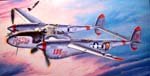
Lightning's Mks. F.1A, 3 and 6

By Dick Smith
Along time ago, Airfix released a 1/72 scale version of the English Electric
Lightning. It was, and is, a very basic kit! The cockpit consists of a "U"
shaped plastic piece that is an ejection seat and a sorry fellow that passes for
a pilot. That's all! (The kit that I have has "Airfix Products Ltd. 1980"
molded to the inside of the fuselage. I'm sure this kit was on the shelves long
before l980.) This Airfix kit is a far cry from their recent release of an
entire series of Lightning's in 1/48 scale. For those looking for a challenge,
this is a good place to start.
Solid research materials are required to detail this kit into a serious replica. Some sources are: Linewrights Aeroguide 8, "BAC Lightning F.Mk.3/Mk. 6," Aircam Aviation Series, No. 37, "English Electric (BAC) Lightning in Royal Air Force and Foreign Service," and Warpaint Series, No.14, "British Aircraft Corporation Lightning."
Airwaves etched brass kit Number 7202 gets the cockpit started with an instrument panel in brass. (This cockpit kit can also be used to build any Lightning kit up to the F. Mk.3.) Lay the brass panel on a thin sheet of plastic stock and cut around it. Paint this backing sheet black.
Paint the brass instrument panel light gray. A dry brushing of flat black with tiny dots of red and yellow will bring out the knobs and switches. Glue the plastic panel to the back of the brass panel. Use tiny dots of five-minute epoxy in the holes of the brass to simulate the "glass" of the instrument lenses. Next cut a 15mm by 20mm sheet of plastic for the cockpit floor. Brass side consoles are provided. I set thin plastic strips at a 90-degree angle to the floor to support the consoles. There are other parts to the kit including rudder pedals, etched seat belts, a "heads-up-display" sight, and a canopy rear view mirror.

The
Airfix ejection seat in the kit is useless. Aeroclub produces a Martin
Baker Mk. 4BS seat in white metal. This seat is quite good and after painting
and dry brushing, appears as authentic as many of the new resin moldings.
The white metal seat also acts as a "weight" to keep the model from
becoming a "tail sitter." All Lightning's had light gray cockpits.
(The Ian Allan Aircraft Illustrated Special "Lightning" by Roger Lindsey
has cockpit photos on page 12.) I painted mine Light Aircraft Gray with
a wash of flat black to bring out the details. The ejection seat has flat
black frames with khaki or medium green cushions. Seat belts are tan or
off white. Even though Aeroclub has molded belts on the seat, I added some additional
paper belts and metal buckles to add a three dimensional effect. The ejection
handles on the top of the seats are striped black and yellow. A wash of flat
black finishes the seat.
Fit the fuselage sides together and check alignment. Do not cement the parts
together at this time. The super detailer will want to construct a rectangular
box for the nose gear bay. Detail the inside with strip and sprue to simulate
piping and electrical boxes. Check references for details. When the nose
gear well is complete, cement it and the cockpit into one of the two halves
of the fuselage. Check for correct alignment and cement the fuselage parts
together. The area behind the seat needs detailing. A few squares of plastic
and stretched sprue to duplicate wiring and piping will go a long way. Be sure
to detail the cover over the instrument panel. The Airwaves brass "HUD"
can be used in this location.

Cut a disk of thin plastic slightly smaller than the outside diameter of the nose ring. Paint it flat black and cement it to the inside of the ring. This will block the view of the front of the new nose gear bay and any "see through" effect in the fuselage. Attach the nose ring but do not attach the pitot tube at this time. Place a strip of plastic, painted flat black, over the holes on the back of the jet exhaust pipes. Cement the jet pipe unit to the rear of the fuselage. The fit of the nose ring and jet pipes is only fair so be prepared to do some filling and sanding. There is not much else to do with the fuselage except to sand off the raised panel lines.
Next move to
the wings. The wheel wells here are quite shallow but a few simulated hoses
made from stretched sprue will pass for hydraulic lines. Attach the wings,
horizontal stabilizers, and the vertical stabilizer. There will be some filling
around these joints to get a smooth fit. Most early Lightning's appeared in
natural metal. I polished my kit with fine grade sandpaper and plastic polish to
get a smooth finish for the natural metal paint. When I was satisfied that I had
obtained a mirror-like surface, I sprayed an overall coat of gloss black paint.
This has a
twofold purpose. First, it would show up any flaws in the sanding and filling
and second, it would provide a base for the metalizer. The black undercoat
would also serve to darken up the bright aluminum finish and make it look worn
and slightly oxidized.
Modeldecal
produces many sheets for the Lightning. Since my kit was an F.1A, I chose
XR-711:A, from 111 Squadron in the early '60's. (Later information shows my
model should have been numbered XM-184. XR-711 was a Mk. 3 in similar colors.)
Give the vertical stabilizer and spine another coat of gloss black. Carefully
mask off the canopy and paint the frame gloss black. The antiglare panel in
front of the cockpit and the cockpit windscreen framing is flat black. The
spines and vertical tails of "Treble One" aircraft were glossy black with yellow
and red markings. Carefully mask off all of the black areas in preparation for
the natural metal coats. There are many products available for this job. My
favorite is the Model Master "metalizers."
After several
light coats of "aluminum plate," I masked areas of the wings and fuselage with
3M "Post It" note pads. The adhesive on these pads will not "lift" the fragile
metal finish and allow the spraying of different shades of metalizer to give a
look of realism. As soon as I was finished spraying the metal colors, I removed
the masking. (Removing the masking as soon as you have completed spraying keep
colors from building ridges where they abut.) When the metal coats are dry,
lightly buff the metal paint with a soft cotton cloth. This gives a burnished
effect to the finish. Since the surface of the model is glossy, there is no
need to apply a decal base coat. Modeldecal provides all of the yellow
"lightning" flashes, squadron insignia, and roundels that make this aircraft a
colorful standout.

After I finished all of the painting and decaling, I set it aside to dry completely. I use rubber gloves to handle the natural metal finish since fingerprints will mar the fragile paint.
The undercarriage of the Lightning is next. The kit doors are too thick and should be replaced with thin plastic sheet. The Airwaves cockpit set provides brass parts for the nose gear doors and blade antennas. The main and nose gear legs can use some brake and hydraulic lines made from stretched sprue. I painted the tires Gunze Sangyo "tire black" and then used a sanding stick to slightly flatten them Last project was to clean up, paint, and detail the Firestreak missile used by the F.1A. The missiles in the Airfix kit are crude and the fins too thick. I replaced the fins with brass scraps taken from the Airwaves cockpit kit. Firestreak missiles are gloss white with black bands. The "seeker nose" is flat black.
(There are good close up shots of Firestreak and Red Top missiles in the Linewrights "Lightning" book.)

I was pleased with the completed F.1A and decided to build a Lightning F. Mk.3,
also from Airfix. Again the cockpit was detailed using the Airwaves set and the
Aeroclub ejection seat. Using the same references and Ian Black's book
"Lightning," the F.Mk.3 was modeled after the 10th anniversary Lightning
Training Flight's XR-749:DA. The decals came from another Modeldecal sheet.
The spine and vertical stabilizer are painted glossy royal blue. The rest of
the aircraft was finished in Light Aircraft Gray (BS381C/627) Gunze Sangyo 332
over Barley Gray (BS4800/18B21) Gunze Sangyo 334. The aircraft uses pink and
pale blue roundels with white stenciling, wing-walks, and numbers.
The F. Mk. 3 version of the Lightning could be armed with either the Firestreak or the much improved Red Top missiles. Red Top bodies were painted matte olive green or medium gray with yellow and black stripes and black fins. The seeker head appeared to be gloss black. I armed my Mk.3 with Red Tops provided in the Hasegawa Mk. 6 kit. These kit missiles are fine and only need a little thinning of the fins with fine sanding
Hasegawa produces a F. Mk. 6 kit, but sadly this cockpit is not much better than
the one in the Airfix kit of the '70's. There is a set of over-wing fuel
tanks and the fuselage has been
molded with the full-length fuel tank and gun pack. I used another Airwaves brass cockpit set made for the Mk.6 version. Unlike the earlier Lightning's, these cockpits were light gray. The instrument panel was different and had a large radar screen on the upper right side. The ejection seat had gloss black seat frames, tan cushions, bright blue leg restraints, and off-white belts with silver hardware. The ejection handles were striped black and yellow or red and yellow.
Hasegawa provides kit decals to depict either XR-725 from 11 Squadron or XR-728 from the Lightning Training Flight. While these markings are fine, I chose XS-903:BA, the leader's aircraft from 11 Squadron. The spine and vertical tail are gloss black. The rest of the aircraft was done in the two-tone gray described earlier on the Mk. 3 kit. Hasegawa provides all of the white stenciling and wing-walk areas. The white wing stripes are thin and require careful application.

Lightning's today only exist in museums and as gate guards. With a few exceptions, they appeared in many colorful schemes during their years of service. While the 1/72 scale kits leave much to be desired, a little extra work, some aftermarket brass and decals, will allow you to make quite a respectable model of one of the most important interceptors in British aircraft history.